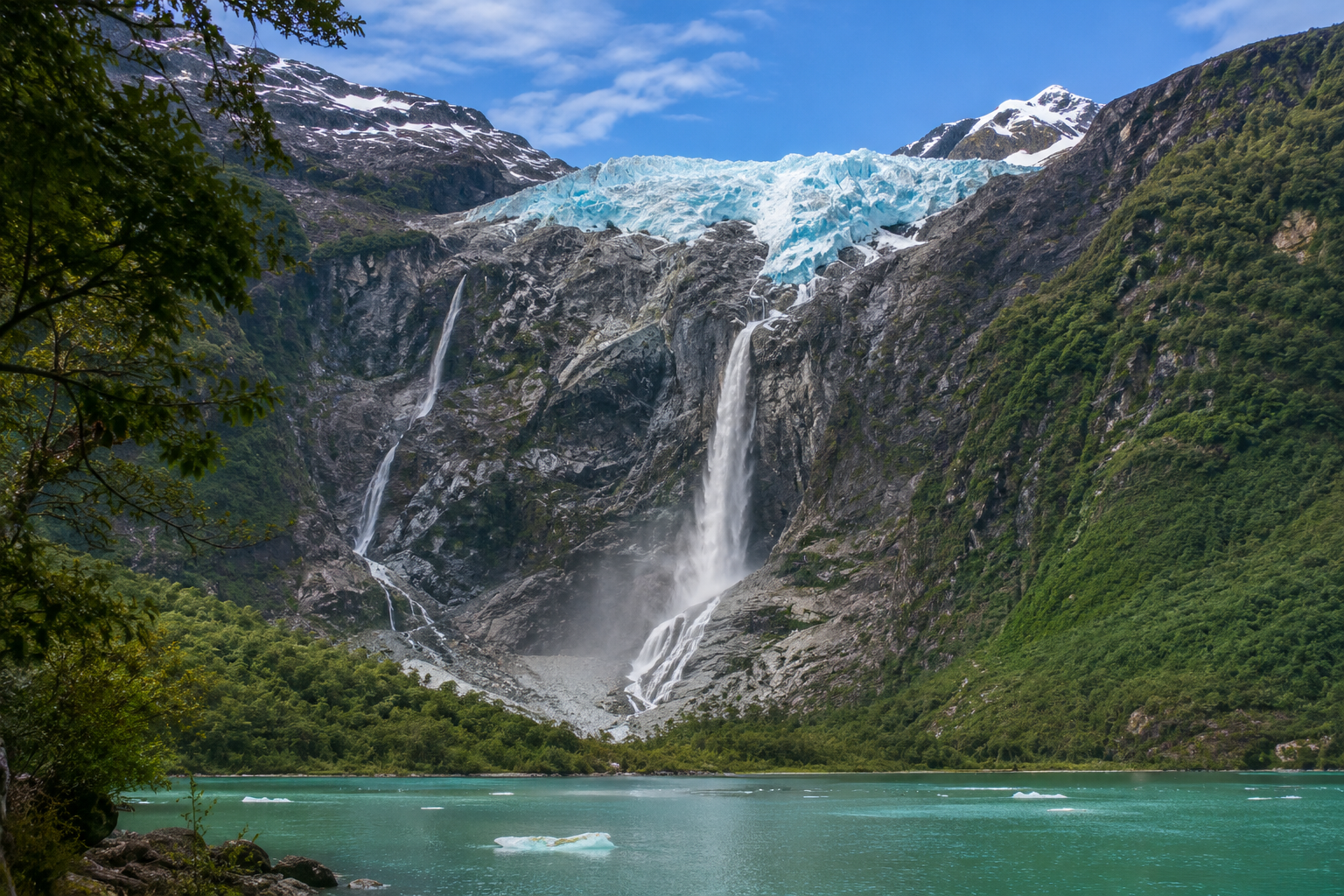
Somewhere along Chile's Carretera Austral, there's a glacier that apparently didn't get the memo about where glaciers are supposed to be.
Most glaciers I've encountered in Alaska and British Columbia have been reasonably well behaved. They flow down valleys, spill into lakes, or occasionally break off enormous chunks of ice with a sound resembling a freight train crashing into a swimming pool. They're spectacular, certainly, but they generally follow a recognizable set of rules.
Then there's the Hanging Glacier of Patagonia.
High above a lush green rainforest in Queulat National Park, an enormous mass of ancient blue-white ice sits perched on the mountainside, seemingly suspended over a cliff. Below it, waterfalls plunge hundreds of feet toward a glacial lagoon, while thick forests cover the surrounding mountains. It's an almost absurd combination of landscapes. A glacier that looks as though it belongs in Antarctica, waterfalls worthy of a tropical rainforest, and enough greenery to make western Washington look positively arid.
Naturally, I have to see it.
The glacier is called Ventisquero Colgante, which translates to Hanging Glacier. It's one of the most famous natural wonders along the Carretera Austral, and it has earned a prominent place on my list of things to investigate during my solo Patagonia scouting adventure in February and March 2027.
I've been looking at photographs of this place for weeks, and I keep wondering whether the real thing can possibly live up to the pictures. The glacier appears to cling to the mountainside like an enormous frozen waterfall. Beneath it, actual waterfalls tumble down dark rock cliffs, disappearing into the forest and eventually reaching Laguna Témpanos, a beautiful glacial lagoon at the bottom of the valley.
It's almost as though someone decided to combine the best parts of Alaska, the Pacific Northwest, and a tropical rainforest, then forgot to tell the glaciers they were supposed to stay somewhere cold.
But the ice is only part of the attraction. Queulat National Park protects a remarkable stretch of Chile's temperate rainforest, where towering trees, moss-covered branches, ferns, and thick vegetation thrive in one of the wettest regions of Patagonia. The forest itself sounds extraordinary, and I'm looking forward to experiencing the contrast between the lush green valley and the enormous mass of ice looming above it.
The park is located along the Carretera Austral, roughly 20 kilometers south of the small town of Puyuhuapi. I'll be traveling through this area in my Yeti Camper, and I suspect I'll be giving myself considerably more time than the average visitor to explore. After all, one of the advantages of traveling alone with a camera and a camper is that nobody can complain when I decide to spend another hour photographing the same mountain.
Well, nobody except me, when I discover I've forgotten to eat lunch.
There are several ways to experience the Hanging Glacier, and that's one of the things I'm particularly interested in investigating. A short trail leads to a panoramic viewpoint, offering an introduction to the landscape without requiring a major expedition. Another route, the Morrena Trail, climbs through the forest toward a more elevated view of the glacier and lagoon. It's a longer outing, but one that sounds particularly rewarding for someone carrying a camera.
And then there's the option that may turn out to be my favorite: getting out onto the lagoon itself.
Boat excursions on Laguna Témpanos offer visitors a different perspective of the glacier and its surrounding mountains. From the water, you can appreciate the enormous scale of the valley, the waterfalls descending from the ice, and the dense forest rising around the shoreline. Depending on conditions, there may even be small pieces of ice floating in the lagoon. I can already imagine sitting in a little boat, looking up at this extraordinary wall of ice, and wondering how something so enormous manages to remain attached to the mountain.
I'm also curious about the sounds. Glaciers aren't necessarily quiet places. Ice moves, cracks, and occasionally breaks apart, sometimes producing deep rumbles that echo through the surrounding valleys. I've heard glaciers making those sounds in Alaska, and there's something unforgettable about it. You can be standing in complete silence, admiring the scenery, when suddenly the mountain seems to clear its throat.
It's a rather effective reminder that nature is still very much at work.
Of course, Patagonia has another way of reminding visitors who's in charge: the weather.
Queulat is famous for its rain, clouds, and rapidly changing conditions. On a clear day, the Hanging Glacier can be a spectacular sight, its brilliant ice standing out against the dark mountains and green forest. On another day, clouds may drift through the valley and hide much of the glacier from view. It's entirely possible to arrive expecting one of the world's great landscapes and discover that Mother Nature has pulled the curtains.
This is precisely why I'm taking my time on this trip. I'll have some flexibility in my schedule, and if the weather isn't cooperating, I may be able to wait for better conditions. I rather like the idea of waking up in the camper, making coffee, checking the sky, and deciding whether the glacier is ready for its close-up.
And if it isn't, I suppose another cup of coffee is a perfectly respectable alternative.
But I'm not heading to Queulat simply to admire a glacier and take a few hundred photographs. Allison and I are planning our first VanArnam Adventures journey through Patagonia in March 2028, and this is exactly the sort of place I want our guests to experience.
The challenge, as always, is figuring out how to do it well.
I don't want to create a trip where everyone rushes off a vehicle, takes the obligatory photograph, and climbs back aboard before they've had a chance to appreciate where they are. I'd much rather give people time to enjoy the setting, perhaps take a gentle walk through the forest, explore the lagoon by boat, and simply absorb the extraordinary scenery.
I'll be evaluating the different trails, the boat experience, the logistics, and how much time we should devote to the area. Some of our guests enjoy hiking, while others prefer a more relaxed approach to exploring. My goal is to find a way for everyone to have a wonderful experience without making anyone feel that they need to conquer a mountain before they're allowed to enjoy lunch.
I'll also be looking at the surrounding area, particularly Puyuhuapi and its remarkable lodge across the fjord. The idea of combining a visit to the Hanging Glacier with an overnight stay at Puyuhuapi Lodge & Spa is especially appealing. Imagine spending the morning exploring a glacier and the afternoon soaking in natural hot springs overlooking a Patagonian fjord. Follow that with a wonderful dinner and a comfortable bed, and I think we've stumbled onto a rather compelling travel formula.
Ice in the morning. Hot springs in the afternoon. Chilean wine in the evening.
There are worse ways to spend a day.
One thing I find especially fascinating about the Hanging Glacier is that it offers a very different experience from the great glaciers of Alaska. In Alaska, I've often associated glaciers with vast, open landscapes, snow-covered mountains, and enormous fields of ice. Here, the glacier seems almost out of place, suspended above a dense green rainforest. That contrast is what makes it so visually extraordinary.
There's also a more sobering side to the story. Like many glaciers around the world, Ventisquero Colgante has retreated over time. The landscape we see today is not exactly the same as the one explorers encountered generations ago, and it will continue to change. I think that makes visiting places like this even more meaningful. They're not static monuments. They're living, changing landscapes, and each visit captures a particular moment in their history.
I don't know exactly what the weather will be doing when I arrive. I don't know whether I'll have brilliant sunshine, drifting clouds, or one of those Patagonian rainstorms that seems determined to test the waterproofing of everything I own. And I certainly don't know whether the glacier will reveal itself immediately or make me wait.
But I do know that somewhere along that road, I'm going to park my Toyota, grab my camera, and head into the forest to see a glacier that has apparently decided gravity is more of a suggestion than a rule.
And if the photographs are even remotely accurate, I suspect I'll spend a fair amount of time standing there with my mouth open.
Which, now that I think about it, is probably not the best thing to do in a rainforest.
— Kent