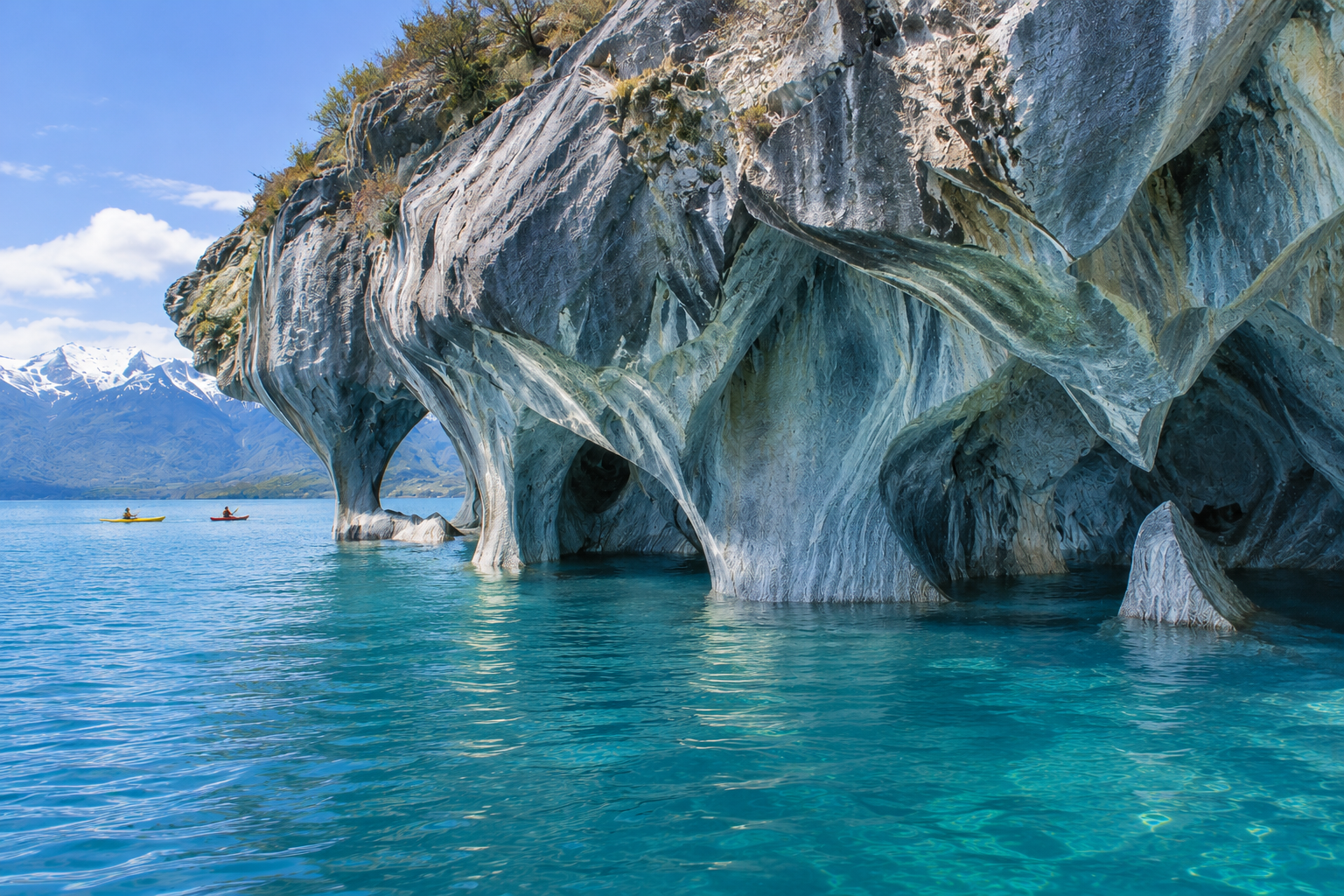
I've seen some remarkable things in my travels. Glaciers in Alaska, spectacular mountains in the Canadian Rockies, ancient European villages, and a few hotel bathrooms so extravagant they probably required their own architect. But somewhere deep in Chilean Patagonia, there's a place that makes all of those fancy marble bathrooms look rather ordinary.
It's called the Marble Caves, and Mother Nature has apparently spent thousands of years working on a sculpture project without once asking for a building permit.
I've been studying photographs of these extraordinary formations as I prepare for my solo journey down the Carretera Austral, and I keep coming back to the same question: How can something like this actually exist? Imagine enormous chambers of swirling blue, white, and gray marble, carved into graceful arches and twisting tunnels, with impossibly turquoise water flowing beneath them. The stone looks almost liquid, as though someone poured different shades of marble into a giant mixing bowl and forgot to let them settle.
And the remarkable part? No sculptors, no architects, no construction equipment. Just water, rock, time, and an almost unreasonable amount of patience.
The Marble Caves are located on General Carrera Lake, an enormous body of water shared by Chile and Argentina. On the Chilean side, it's called Lago General Carrera, and it's the largest lake entirely or partly within Chile. Its waters are fed by glaciers and rivers descending from the surrounding mountains, carrying fine glacial sediment that helps give the lake its extraordinary turquoise and blue colors. The lake is so large that it can feel more like an inland sea, complete with powerful winds and waves that occasionally remind visitors that Patagonia is not particularly interested in their vacation schedules.
The caves themselves are near a little village called Puerto Río Tranquilo, which translates rather charmingly to "Tranquil River Port." I haven't been there yet, but I already like the sound of it. After days of driving a Toyota camper through the wilderness, a village with "tranquil" in its name seems like an excellent place to stop. Of course, this being Patagonia, I suspect the tranquility depends somewhat on the wind.
From the village, visitors board small boats or kayaks and head out across the lake toward the marble formations. There are three famous features: the Marble Chapel, the Marble Cathedral, and the Marble Caverns. The names sound like something you might find in Italy, except these cathedrals have no stained-glass windows, no pews, and absolutely no collection box. Their architect was water, and the construction schedule stretched across thousands of years.
The waves have slowly worn away the marble, creating extraordinary arches, chambers, and passageways. In places, the rock has been sculpted into smooth, flowing shapes that seem almost impossible for solid stone. Light reflects off the water and dances across the walls, turning the marble shades of blue, green, silver, and white. As the sun moves, the colors change. Even the water level makes a difference, revealing or concealing openings and changing what visitors can see.
For someone who enjoys photography as much as I do, this sounds like a particularly wonderful way to lose track of time.
I'll be bringing several cameras, lenses, and enough photography equipment to make airport security wonder whether I'm opening a camera store in Chile. But the Marble Caves present an interesting challenge. Unlike photographing a mountain, where you can set up a tripod and wait patiently for the perfect light, I'll be working from a moving boat or possibly a kayak. That means thinking carefully about camera settings, reflections, movement, and how to capture the scale of these remarkable formations without dropping something expensive into one of South America's largest lakes.
I've already decided that the camera strap will be getting considerably more attention than usual.
One of the things I'm particularly interested in is whether to explore the caves by motorboat or kayak. A boat would be comfortable, efficient, and probably the easiest way to see the major formations. Kayaking, on the other hand, offers the possibility of moving quietly through the water, slipping into smaller openings when conditions permit, and experiencing the caves at a wonderfully unhurried pace. There's something appealing about paddling beneath a massive marble arch while the lake reflects those beautiful blue patterns all around you.
Then again, there's also something appealing about sitting comfortably in a boat while someone else does the navigating.
I may investigate both options.
And this is where my little scouting adventure becomes more than simply a personal photography trip. Allison and I are planning a small-group journey through Patagonia in March 2028, and the Marble Caves are exactly the kind of experience I hope to include. But I don't want to simply book an excursion because the photographs look spectacular. I want to understand what the experience actually feels like, how the local operators work, what the boats are like, and how we might create something particularly memorable for our guests.
Could we arrange a private excursion for our group? Would an early-morning departure give us calmer water and beautiful light? Could we spend a little more time exploring rather than following a rushed schedule? And might there be an opportunity for some of our guests to kayak while others enjoy the caves from a boat? These are the sorts of questions I'll be asking when I arrive in Puerto Río Tranquilo.
There's one rather important detail to consider: the weather. Patagonia has a reputation for wind, and General Carrera Lake is no exception. Boat trips depend on safe conditions, and even a beautiful sunny morning doesn't guarantee that the lake will remain cooperative. The water level can also affect which caves and passages are accessible. I've learned that when you're traveling in remote places, the best itinerary is often one with enough flexibility to let nature have the final word.
That's another reason I'm looking forward to spending time here rather than simply arriving, taking a few photographs, and rushing off to the next destination. I want to get to know the village, talk with the local guides, find a good place to eat, and perhaps discover a comfortable lodge overlooking the lake. If the weather delays my excursion, I imagine there are worse places in the world to spend an extra day.
I'm also fascinated by the fact that these caves aren't hidden deep underground. They're right there at the edge of the lake, their beautiful sculpted walls rising directly out of the water. You don't need ropes, helmets, or a willingness to squeeze through a dark tunnel. You simply approach by boat and watch an extraordinary landscape unfold in front of you.
And unlike so many famous attractions around the world, the Marble Caves aren't something humans built to impress one another. They're the result of natural processes operating on a timescale almost impossible to comprehend. Long before anyone dreamed of a road through Patagonia, long before the first tourist arrived with a camera, water was already carving these remarkable shapes into the stone.
There's something wonderfully humbling about that.
I suspect the moment that will stay with me isn't going to be the first photograph I take. It will be the moment the boat rounds a corner and I see those enormous marble arches rising above the turquoise water for the first time. The sort of moment when you stop thinking about cameras, itineraries, and the next destination, and simply stare.
That's what I love about travel. Every now and then, you come across a place that makes you feel like a kid again, looking at something extraordinary and wondering how on earth it happened.
And if the Marble Caves turn out to be even half as beautiful as the photographs suggest, I have a feeling they'll become one of the highlights of my Patagonia journey.
Perhaps even one of the highlights of our 2028 adventure.
But first, I need to get there. I'll be making my way south in the Yeti Camper, following the Carretera Austral through mountains, forests, and remote villages until I reach the shores of General Carrera Lake. Then I'll find a local guide, climb aboard a boat, and head out to see what several thousand years of water and marble can accomplish.
I'm expecting something extraordinary.
And if I come home with a few hundred photographs of blue marble, I hope Allison will understand. After all, I could have developed an expensive interest in collecting antique sports cars.
Actually, come to think of it, perhaps photography isn't my only expensive hobby.
— Kent