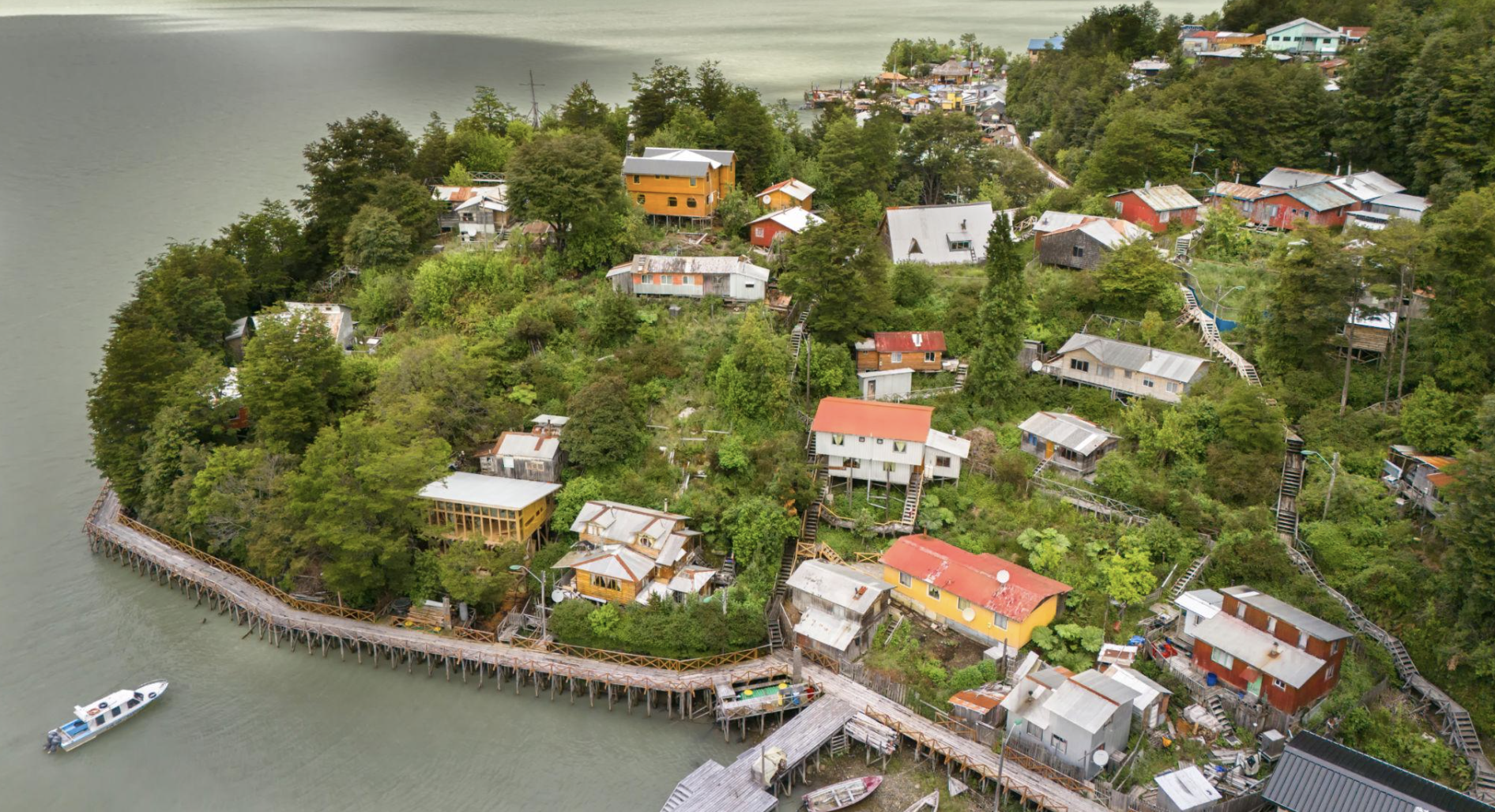
Imagine living in a village where there are no streets. No cars parked outside the houses, no traffic lights, no driveways, and absolutely no possibility of ordering a pizza and telling the delivery driver to leave it on the front porch. Instead, your entire town is connected by wooden boardwalks that twist along a fjord, climb through the forest, and connect houses perched on rocky hillsides. Your neighbors are reached by walking up and down wooden staircases, the waterfront is your main street, and the surrounding mountains look as though they belong in a National Geographic documentary. Welcome to Caleta Tortel, a tiny village in southern Chile that I've become completely fascinated with, and one I'm hoping to visit during my journey down the Carretera Austral.
What first caught my attention wasn't the scenery, although it's spectacular. It was the question of why anyone would build a village in a place where you couldn't build roads. The answer turns out to be a wonderful story of determination, ingenuity, and people adapting to a landscape rather than trying to force the landscape to accommodate them. Caleta Tortel sits near the mouth of the Baker River, surrounded by fjords, steep hillsides, dense forests, and ground that can be rocky, wet, or downright swampy. When settlers began establishing a community here, traditional streets weren't particularly practical. So they built something else: elevated wooden walkways using the region's Guaitecas cypress, a durable timber that was also central to the local economy. Over time, these walkways connected homes, docks, businesses, and public buildings, eventually creating an extraordinary pedestrian network stretching more than six kilometers through the village.
And here's the part I find remarkable. Although Caleta Tortel was officially established in 1955, it wasn't connected to the rest of Chile by road until 2003. Think about that for a moment. While the rest of us were becoming increasingly dependent on highways, automobiles, and the convenience of having everything delivered to our doorstep, the people of this little Patagonian village were getting on with life in a place reached primarily by water. Supplies arrived by boat, timber was transported along the rivers and fjords, and the community developed its own way of doing things. It wasn't some quaint experiment in alternative living. It was simply what worked. And when the road finally arrived, the village didn't suddenly abandon its wooden walkways and start paving parking lots. The boardwalks remained the heart of the community.
I love that. There's something wonderfully appealing about a place that has managed to preserve such a distinctive character, not because someone designed it to attract tourists, but because generations of residents figured out how to make a life there. The village's timber history is particularly interesting. The surrounding forests once supported an economy built around harvesting Guaitecas cypress, and workers transported timber through the waterways of the Baker River region. The history wasn't always romantic, and the exploitation of the region brought considerable hardship and environmental consequences. But the village that emerged is a remarkable example of how people adapted to a challenging environment. Today, its unusual architecture and pedestrian network are recognized as an important part of Chile's cultural heritage.
I'm already imagining my arrival. I'll drive the Toyota Hilux camper down the access road, find somewhere appropriate to park, and then do something rather unusual for a road trip: leave the truck behind and explore an entire village on foot. I suspect I'll be carrying my camera, a couple of lenses, and perhaps a rain jacket, because this part of Patagonia apparently considers rainfall less of a weather event and more of a lifestyle choice. The boardwalks will take me past wooden houses, little shops, guesthouses, and docks where boats come and go. Some paths follow the waterfront, while others climb through the trees, offering views across the fjord and surrounding mountains. There are staircases, bridges, and little turns that look as though they might lead somewhere interesting. This is exactly my kind of place, where the best plan is to have no particular plan at all.
And then there are the people. This is what really interests me about Caleta Tortel. What is everyday life like in a community where you can't simply drive to someone's house? How do families carry groceries home? What happens when someone needs a new refrigerator? How do children get to school, and what is it like growing up in a place where the forest, the fjord, and the mountains are such a constant part of daily life? I'm hoping to meet a few residents, perhaps over coffee or lunch in a little restaurant, and learn something about their lives. I have a particular admiration for people who know how to build things, repair things, and solve problems with whatever materials and resources are available. I suspect a village built on wooden walkways in one of the wettest corners of Patagonia has produced more than a few people who know their way around a toolbox.
The photography possibilities are extraordinary. I can imagine weathered wooden houses reflected in still water, fishing boats tied to little docks, narrow boardwalks disappearing into lush green forest, and clouds drifting through the mountains behind the village. I'd love to photograph the details that tell the story of the place: the worn boards underfoot, the construction of the walkways, the little staircases connecting homes, and the way the buildings fit into the landscape. But I'll be just as interested in putting the camera away and enjoying the atmosphere. A village like this deserves more than a quick stop for photographs. I'd like to find a little restaurant, order something local, and spend an hour watching life unfold. Perhaps fresh fish or seafood, perhaps a bowl of something warm and delicious, and hopefully a conversation with someone who has lived there long enough to remember what life was like before the road arrived.
There's another fascinating piece of history nearby. At the mouth of the Baker River lies Isla de los Muertos, or Island of the Dead, a small island associated with the deaths of workers during an early twentieth-century colonization and timber enterprise. The story is a sobering reminder that Patagonia's history isn't simply one of beautiful scenery and adventurous pioneers. It also includes isolation, hardship, and people who paid an enormous price trying to establish lives in this remote region. Guided boat visits may offer an opportunity to learn more about that history, and it's something I'd like to investigate while I'm there. Understanding a place means appreciating both its beauty and the more difficult stories that shaped it.
Naturally, I'm also thinking about whether Caleta Tortel could become part of our VanArnam Adventures Patagonia trip in March 2028. It's certainly not the sort of place where I'd want to arrive with a large group and rush everyone through on a tightly scheduled sightseeing tour. The appeal is precisely the opposite. I'd love to give our guests time to wander, take photographs, enjoy lunch, and discover the village at their own pace. Perhaps we could arrange a local guide to share its history and introduce us to some of the people who call it home. But first I need to experience it myself, understand the logistics, and decide whether it fits naturally into the journey. The village is farther south than some of our other potential stops, so I'll be paying attention to the driving distances and how much time it deserves.
What I find most compelling about Caleta Tortel is that it challenges our assumptions about what a town is supposed to look like. Most of us take roads, driveways, and parking lots for granted. We build communities around automobiles and then spend a surprising amount of our lives sitting in them. Here is a village that developed an entirely different solution, where walking is woven into daily life and the connection between people, buildings, forest, and water is impossible to ignore. I'm not suggesting that carrying a week's groceries up several flights of wooden stairs in the rain sounds particularly appealing. In fact, I suspect that after doing it a few times, I'd develop a sudden appreciation for the convenience of my driveway back home. But there's something admirable about a community that has made this extraordinary place work for generations.
So Caleta Tortel has earned a spot near the top of my list of places to explore. I don't know exactly what I'll find when I arrive, who I'll meet, or whether the weather will cooperate. I suspect I'll get a little wet, climb more stairs than expected, and take far too many photographs of wooden walkways. But I'm hoping to come away with something more interesting than a collection of pretty pictures. I want to understand why people chose to build a life here, how they've adapted to the landscape, and what makes this little community so special.
And if I happen to meet someone who has figured out an ingenious way to move a refrigerator up a steep wooden staircase, I'll definitely be asking how they did it.
Because that's the sort of practical knowledge I find fascinating.
And because I'm fairly certain that someday, somewhere, Allison will ask me to move something equally ridiculous.
— Kent